Nanotechnology Line Icons: A 50-Piece Green & Black Set for Modern Design
In the fast-evolving world of science and technology, visual communication needs to be both precise and engaging. If you are working on a project related to research, biotechnology, or advanced engineering, generic stock imagery often falls flat. You need specific, clear, and scalable graphics that speak the language of the industry. This is where the 50 Nanotechnology Line Green Black Icons set becomes an indispensable part of your design assets library. It bridges the gap between complex scientific concepts and clean, modern typography aesthetics, offering a visual language that is both professional and accessible.
The Visual Personality of Precision
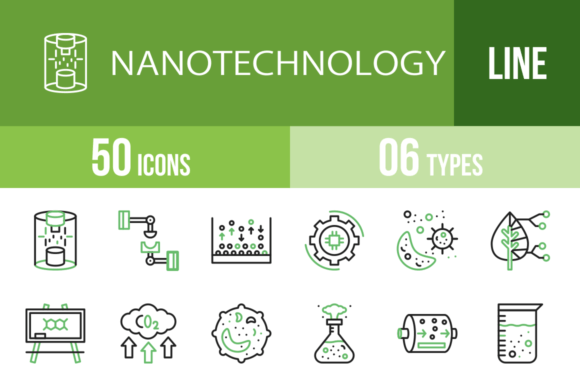
The style of the 50 Nanotechnology Line Green Black Icons is defined by its adherence to the unigrid system. This isn't just a random collection of drawings; it is a cohesive set where every element—from the DNA helix to the Solar Panel—sits on a consistent pixel grid. Visually, the set balances technical accuracy with a modern, "tech-forward" personality. The primary use of black lines ensures maximum contrast and readability, while the strategic application of green accents introduces a sense of growth, biology, and eco-friendly innovation. This dual-color approach creates a clean, high-tech look that avoids the clutter of full-color illustrations.
Because these are 100% vector icons, they function much like a high-quality premium font. They are infinitely scalable without losing sharpness. Whether you are designing a tiny favicon for a browser tab or a massive banner for a conference backdrop, the lines remain crisp. This vector nature makes them easy to edit. If your brand identity uses a specific shade of neon green rather than the provided emerald, you can adjust the color codes in seconds using standard vector software like Adobe Illustrator or CorelDRAW.
Strategic Applications: From Lab to Market
For designers and entrepreneurs, the versatility of the 50 Nanotechnology Line Green Black Icons is a significant advantage. These graphics are designed for maximum usability across multiple platforms. Here is how different professionals can leverage this set:
- Mobile App and Web Design: In UI/UX design, clarity is king. Icons like Microscope, Nanobot, and Monitor are perfect for navigation menus, feature lists, or onboarding screens in health-tech or science education apps. Because the set includes formats like SVG and PNG, they load quickly and look sharp on high-resolution Retina displays.
- Presentation and Editorial Design: If you are a researcher or a startup pitching to investors, slide decks can often become text-heavy and boring. Using icons like Research, Formula, and Automated Engineering helps break up walls of text, creating a strong visual hierarchy. In editorial design, such as science magazines or white papers, these icons act as effective visual anchors for sidebars and pull quotes.
- Marketing and Branding: For small business owners in the biotech sector, consistency builds trust. Incorporating these icons into your social media graphics, email newsletters, and packaging design ensures that your visual language is consistent. It signals to your audience that your brand is detail-oriented and professional.
Practical Guidance for Implementation
Integrating a new set of design assets into a workflow requires a bit of strategy to ensure they enhance rather than distract. When working with the 50 Nanotechnology Line Green Black Icons, consider the following practical tips:
Evaluating Fit and Font Pairing
Icons are visual companions to your text. To get the most out of this set, you need to pair them with the right typeface. Given the clean, line-art style of the icons, they pair exceptionally well with sans serif fonts that have a geometric or humanist structure. Fonts like Montserrat, Roboto, or Open Sans share the same modern, uncluttered DNA as these icons. Avoid overly decorative script fonts or heavy serif fonts, which can clash with the technical precision of the line art. The goal is to create a seamless reading experience where the icons and text feel like they belong to the same family.
Contextual Usage
Not every icon will fit every context. The set includes highly specific items like Atomic Layer Deposition and Ferrofluid, as well as general concepts like Science Book and Light Bulb. When designing for a general audience, stick to the recognizable symbols to aid quick comprehension. When designing for a niche audience of engineers or scientists, you can utilize the more complex icons to demonstrate deep industry knowledge.
Technical Optimization
The set comes in six different formats: AI, CDR, EPS, JPG, PNG, SVG. For web design, always opt for the SVG format. SVGs are code-based, meaning they are incredibly lightweight and can be manipulated with CSS (for example, changing the color on hover). For print projects, use the AI or EPS formats to ensure the vectors remain perfectly sharp regardless of the DPI requirements.
Enhancing User Engagement
Ultimately, the goal of any visual asset is to improve communication. In the realm of modern typography and design, icons serve as a universal language. By using the 50 Nanotechnology Line Green Black Icons, you are not just decorating a page; you are improving cognitive processing for your viewer. A well-placed icon next to a service offering—like Self Assembly or Quantum Dot—allows users to scan content faster and retain information better.
For content creators and bloggers, these icons can revitalize a standard layout. Instead of using bullet points, use the Hexagon or Layer icons to list features. This small change elevates the perceived value of your content, making it feel more like a curated premium font experience rather than a standard blog post.
Whether you are building a logo design for a new startup, creating a pitch deck, or designing a user interface for a mobile app, having a reliable set of vector icons is crucial. This collection offers the flexibility, scalability, and professional aesthetic required to meet the high standards of the technology and science sectors.